Knowing how to buy property in Turkey is straightforward. However, to navigate this market with ease, it is worth understanding the laws and market trends. Turkey is the crossroads of East and West, a position reflected in the real estate market.
Buyers include British nationals, UK buyers (including those from Northern Ireland), and global investors. Whether they have bought summer holiday homes, retirement homes or made a real estate investment, they enjoy the benefits of ownership.
Turkey’s real estate market has long been a magnet for international investors. Buying property in a foreign country needs a good grasp of local rules and laws. From the initial market analysis and real estate due diligence to receiving the keys, being well-informed ensures a smooth and secure investment.
Quick Summary – How to Buy Property in Turkey
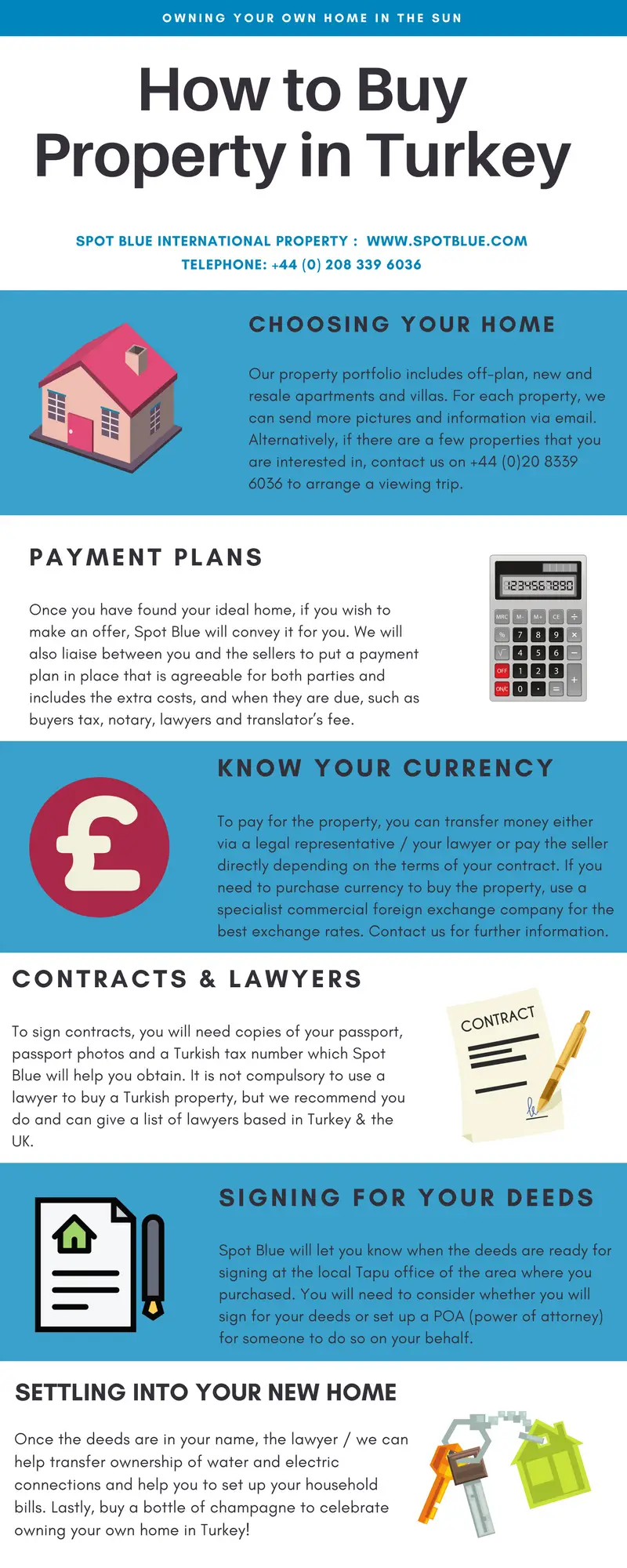
Ready Paperwork: Foreigners need a Turkish Tax ID (Yabancı Kimlik Numarası) and a notarised translation of your passport to open a bank account and start the process. Also open a Turkish bank account because house purchases made in cash cannot get their title deeds. (We help our clients through these steps.)
Hire a Reputable Agency: A good agency knows the market well. They find off-market deals and work closely with sellers.
Preliminary Contracts & Deposits: After the negotiators agree on the price, they sign a sales contract. Pay a deposit to secure the contract.
Official Application: Make applications for title deeds via the randevu.tkgm.gov.tr portal. The GIYKIMBIL system will confirm the seller’s data.
Mandatory Appraisal Report: Before buying, obtain a valuation report from a licensed appraiser. This confirms the market value and ensures tax compliance.
Currency Exchange (DAB): House prices are shown in foreign currencies for the international market, but sales are in Turkish lira. Foreign buyers must exchange their currency for Turkish lira at a government-approved bank. They also need a Foreign Currency Exchange Certificate (Döviz Alım Belgesi) before the title transfer.
DASK Earthquake Insurance: Buyers must have an active Earthquake Insurance Policy (DASK) to complete the transfer.
Tapu Office: The final sale only happens at the Turkish Land Registry Directorate. This is where the TAPU (Title Deed) is issued. Non-Turkish speakers must hire a government-approved sworn translator to sign the title deed. This ensures you fully understand what you sign. Budget the translation fee into your extra costs. This process is to protect foreigners’ rights. You now own a house in the Republic of Turkey.
Extra Costs: Factor in roughly 7–10% of the sale price for Tapu Harcı (transfer tax), notary fees, translation fees, and agency commissions.
POA (Optional): If you can’t be in Turkey for the signing, grant a notarised Power of Attorney to a lawyer or agent to complete the process for you.
Post-Purchase Rights: If you own a home worth $200,000, you can apply for a Residence Permit. Also, if you invest over $400,000, you qualify for the Citizenship by Investment Program.
Residential Properties: Governed by Turkish condominium law (the Condominium Law), which protects owners’ rights in shared buildings. In a building with six or more apartments and an official management committee, owners pay apartment aidat. (Maintenance fees.)
Deep Dive – Understanding the Legal Landscape
1: Who is Eligible to Buy?
Under Turkish Property Law No. 2644 on Land Registry, most nationalities are eligible to acquire real estate. There are rules around military zones. A foreigner can own up to 30 hectares of land.
2: The General Directorate of Land Register and Cadastre
The Land Registry Directorates (Tapu ve Kadastro Genel Müdürlüğü) manage property ownership titles, so each transaction complies with the Civil Code and the Cadastral Law. Buyers can reach the Alo 181 Call Centre for help with land registry questions.
For residential units or large plots of land, consult the General Directorate of Land Registry and Cadastre to verify the property’s status. For added peace of mind, investors use the parselsorgu.tkgm.gov.tr portal to check plot details.
Specific sectors operate via specialised legislation, such as Law No. 2634 on Tourism Incentives, Law No. 4737 on Industrial Zones, and Law No. 6491 on Turkish Oil, which may affect how certain Turkish companies or individuals get land for commercial use.

3: Starting Your Search
No matter if you seek a luxury villa in Antalya or a city apartment in Istanbul, the first step is to find the right neighbourhood for real estate. Work with reputable real estate agents like us to navigate the local market. We can identify high-potential off-plan properties or land plots for custom builds. For Turkish citizenship, the investment threshold is $400,000, while a residency visa requires $200,000. Many refer to these as Turkey’s version of a Golden Visa.
4: Legal and Financial Due Diligence
Before committing, perform thorough real estate due diligence. This includes:
- Property Value Statement: Get an official valuation report from an SPK-licensed expert. This ensures the price matches the deed value.
- Building Regulations: Check that the villa or apartment has a “Habitation Certificate” (Iskan) and meets safety codes.
- Turkish Companies: If buying through a legal entity, ensure all paperwork is in order.
Financial planning should account for notary fees, the 4% title deed transfer tax, and recurring costs like the annual Property Tax. Most international transactions happen via bank transfer, but some buyers use a mortgage from Turkish banks. As of May 2026, a mandatory Secure Payment System will release funds to the seller only after the transfer of deeds. The land registry offices (Tapu office), governed by the Land Register Act is the state’s guarantor of ownership.

5: Required Documents for the Deeds
- Original Passport (and a notarised translation if it isn’t in Latin characters).
- Property Valuation Report (mandatory for foreigners to prevent fraud and ensure tax compliance).
- Tax ID Number (Yabancı Kimlik Numarası).
- DASK Insurance (Mandatory Earthquake Insurance policy).
- Foreign Currency Exchange Certificate (Döviz Alım Belgesi) shows the purchase price was brought into Turkey in foreign currency and exchanged at a bank.
6: Finalising the Purchase and Post-Sale
The FCDO (Foreign, Commonwealth & Development Office) provides regularly updated guidance to help British nationals stay informed about legal requirements. Once the deed is in your name, set up utility contracts for water and electricity. To rent out for short-term stays, register with the GIYKIMBIL system.

7: Post-Purchase Procedure Essentials: Settling In
Once you have your deed, go to public utility companies to set up water and electricity contracts. For new builds, check the habitation certificates (Iskan) to ensure the building meets regulations.
For residency, the Foreigners and International Protection Law No. 6458 allow property owners to apply for a Turkish Residence Permit (Ikamet). The minimum value for a Resident Permit through ownership is $200,000.
8: Turkish Citizenship by Investment
The Citizenship Program, also called the Golden Visa, is a major initiative by the Turkish Ministry of Finance and the Ministry of Foreign Affairs.
- Investment Threshold: $400,000 USD in real estate.
- Key Requirement: Keep the apartment or villa for 3 years, with an annotation on the deed.
- TNP Foreigners’ Department: This department handles the residency and security checks for the application.
9: Turkish Property Transfer Taxes
Property taxes occur in three main stages: purchase costs, annual holding costs, and costs at sale or rent. Recent updates to property valuations (Rayiç Bedel) means tax rates stay the same, but the “tax base” (the calculation value) has risen in many areas. Upon buying a home, these are the primary government-related costs:
- Title Deed Fee (Tapu Harcı): This is 4% of the declared value. While legally split between buyer and seller (2% each), in the Turkish resale market, the buyer pays the full 4%.
- Value Added Tax (VAT/KDV): This applies only to new builds purchased from developers.
- Administrative Fee (Döner Sermaye): A fixed fee for processing the deed. For foreign buyers, this is approximately ₺21,000.
- Stamp Duty: Usually, 0.948% of the sales contract amount if a formal, notarised agreement is signed before the deed transfer.
- Annual Taxes: Ongoing costs paid to the local municipality in two instalments (May and November). Metropolitan areas include Istanbul, Antalya, Muğla (Bodrum), Izmir, and Ankara. This year marks a new “valuation cycle.” Municipalities have updated property values to align with market prices. Annual tax bills will increase because the assessed value of homes was adjusted upward.
- Capital Gains Tax: If you sell within 5 years of buying, pay tax on the profit. After 5 years, you are exempt (for individuals).
- Rental Income Tax: To rent out, income tax is at progressive rates ranging from 15% to 40%. For 2026, there is an annual exemption threshold (approx. ₺58,000); landlords only pay tax on income exceeding this amount.
10: Buying off-plan properties
Buying off-plan is a popular choice for investors. It allows them to secure lower entry prices, usually 20% to 40% below market value, along with flexible payment plans. Turkish law offers strong protections for off-plan buyers in projects with 30 or more units.
For larger projects, developers must provide one of the following options: a Bank Guarantee Letter covering your total investment, a Completion Insurance policy, or a Progress Payment System. In the Progress Payment System, the bank releases funds to the developer upon meeting construction milestones.
To make your investment legally binding, go beyond a simple “Sales Office Agreement.” Instead, opt for a Notarised Sales Promise Contract (Düzenleme Şeklinde Satış Vaadi Sözleşmesi). A contract signed only at the developer’s office cannot be legally enforced for a title transfer.
Sign in front of a Public Notary to make the transaction legal. In most cases, developers issue a “provisional” title deed before completion.
This registers ownership of a “land share” and the unit number at the Land Registry (Tapu office). This protects buyers if the developer faces financial trouble. Ensure the developer obtains the “General Iskan” (Habitation Certificate). A building without an Iskan faces double-utility rates and legal hurdles later. Never use the developer’s recommended lawyer. Hire your own to check for “İpotek” (mortgages) or “Haciz” (liens) on the project land.
11: The Law Regarding Short-term Rentals
Owners can rent out for short-term rentals (defined as under 100 days), but the laws are strict and more actively enforced. The centrepiece of these regulations is the “100-Day Law” (Law No. 7464). To list on platforms like Airbnb or Booking.com, follow legal guidelines to avoid heavy fines.
No one can rent out a property for even one night without a Tourism Rental License (Turizm Konutu İzin Belgesi) from the Ministry of Culture and Tourism. If you rent for more than 100 days, your home is seen as a commercial business, like a hotel. This requires special permits. Once you are licensed, display an official plaque at the entrance.
For apartments, you need unanimous consent from all owners in the building. Some “branded residences” or complexes designed with a “hotel concept” already have this permission in their official management plan (Yönetim Planı).
If yours does, skip the need for individual signatures. Occupancy is capped at 2 people per bedroom, with a maximum of 12 guests regardless of the villa’s size. Also report every guest’s ID/Passport detail to the police via the Kimlik Bildirim System (KBS) within 24 hours of arrival.
12: Property Declaration on the Title Deeds
The Tapu Harcı is the Title Deed Transfer Tax. This is the highest one-time cost when buying or selling property. It remains a key revenue source for the Tapu ve Kadastro Genel Müdürlüğü. The government is stricter about declared property values
The tax is 4% of the declared sales price. According to Turkish law, the buyer pays 2% and the seller pays 2%. In the resale market, standard practice is for the buyer to pay the 4%.
However, in new-build developments, some developers may offer to cover their half (or even the full amount) as a sales incentive. Foreign buyers need an official property value statement from an independent, government-authorised appraiser.
The value declared for the Tapu Harcı must be at the value stated in this report. The declared price should meet or exceed the “Fair Market Value” set by the local municipality. Pay the tax before signing the final signatures on the title deed via state banks (Ziraat Bank, Vakıf Bank, Halk bank) or through the e-Tebligat system.
If you under-declare the price to save on Tapu Harcı, you face two major risks:
- The tax office uses algorithms to flag properties sold below market value. If caught, you will pay the missing tax plus a penalty of 50%–100%.
- If you sell within 5 years, your “profit” will look much higher on paper because you started with a low declared purchase price. This could lead to a massive income tax bill later.
13: Financial and Administrative Steps
The road to ownership involves several key financial commitments. These costs include the appraisal fee for a valuation report and various taxes. These taxes are the Tapu Harcı (Title Deed Fee) and the Emlak Alim/Satim Vergisi (Property Purchase/Sales Tax). High-end investments also face the Valuable Housing Tax.
Some buyers wait for interest rate cuts to get mortgage loans or explore mortgage funds. Others focus on obtaining their Yabancı Kimlik Numarası (Foreigner ID Number) to ease paperwork. Buyers must buy Natural Disaster Assurance (DASK) to guard against seismic risks and ensure the villa or apartment meets current building regulations.
14: Finalising the Deal and Beyond
Once both parties sign the preliminary real estate contracts, the transaction is finalised at the local Title and Deed Office.
If you’re not in Turkey, you can complete some procedures at Turkish consulates abroad. The Foreign, Commonwealth & Development Office (FCDO) offers helpful news and guidance for expats to navigate these waters safely.
Once you own the home, think about making property improvements to boost its value. You might also explore long-term leases for steady income. Keep in mind that selling your property relies on good photography and effective online marketing.
Whether you apply for residency permits or want a holiday home, we are here to help. Reach out to us via WhatsApp for a personalised consultation.
Popular Places to Buy a Home
Istanbul: Turkey’s Largest City
Istanbul is the most popular spot for foreign home buyers, and the steering wheel of the Turkish economy. Outskirt areas are now hubs for residential real estate and infrastructure growth.
As Turkey’s largest city, Istanbul is a centre for tourism, education, art, food, culture, business, and economics. This appeal draws in those looking for mid- to long-term investments. Yali mansions along the Bosphorus are Turkey’s priciest properties.
However, most real estate investment occurs in the outer European districts. Foreign investors prefer off-plan homes. They offer big discounts and flexible payment plans.

Mediterranean Antalya
The Antalya region comprises the city centre and smaller coastal resorts, with a large expat population. Although the Antalya centre is famous, one district that is gaining interest is Alanya, on the outskirts. Several nationalities love the Antalya region for holidays.
Known for Turkey’s best beaches, this region includes smaller coastal towns, each with its own charm. Belek is famous for golf; Side has historical ruins; and Kalkan, on the outskirts, is known for luxurious villas with stunning sea views.

Bursa in Northwest Türkiye
Bursa now ranks among the top five destinations. The main city centre is home to historical landmarks and UNESCO World Heritage Sites. Buying here means enjoying Mount Uludag, Turkey’s best skiing spots.
Bursa may be new to the international market, but it attracts many Middle Eastern nationals. Known as Green Bursa for its lush landscapes, this city offers a blend of urban, rural, coastal, and mountain activities.
Fethiye Region
The Fethiye district in Muğla province is a popular place for tourists and expats. It includes the city centre, Ovacik, Hisaronu, Oludeniz, and Calis Beach. Just an hour from Dalaman airport, this beautiful spot on Turkey’s Mediterranean coast is perfect for sailing. Buying in Fethiye is smart for budget-conscious buyers. Foreign investors appreciate its long-term potential, as it has a solid reputation as a tourism destination.
Bodrum Peninsula
In the Aegean region, the Bodrum Peninsula was the first area to embrace tourism, hence the cosmopolitan feel. Known as a favourite for American celebrities and Saudi royalty, the peninsula caters to budget tourists and foreign homebuyers.
House buyers like Yalikavak for spacious villas with modern designs. Gumusluk is known for charming seaside restaurants, while Golturkbuku commands six-figure home prices, leading the property market. Budget-conscious buyers like Iasos, close to the airport and popular towns such as Gulluk, Gundogan, Kadikoy, and Gumbet.

Often Asked Questions and Answers
Do You Get Residency When Buying Turkish Property?
The residency program and real estate are separate. Buying property doesn’t grant residency. This is a different application process that includes health and financial checks. However, if you buy an investment property worth $400,000, apply for citizenship, giving you full working and living rights.
Is it Safe to Buy in Turkey?
Turkey faced harm from previous careless practices. However, it has since improved regulations to safeguard international investors’ money. Now, estate agents must have licenses and follow legal protocols. Buyers don’t legally need an independent solicitor, but most foreigners hire one. Just follow the legal guidelines and the law when purchasing. Remember that, unlike in other countries, the transfer of title deeds takes as little as a week.
Can foreigners buy a house in Turkey?
In our line of work, people often ask us if foreigners can buy in Turkey. The answer is yes. Many foreigners from different countries legally own apartments, villas, land, and commercial properties. They can buy almost anywhere, except in military zones. Foreigners may own up to 30 hectares or 10% of a district. Citizens from Syria, Armenia, Nigeria, Cuba, and North Korea can’t buy a home. However, all other nationalities can obtain title deeds.
Is it worth buying property in Turkey?
The question of whether it’s worth buying is a resounding “yes” from strategic investors. After years of price hikes due to inflation, the market shifted to steady, demand-led growth. This meant nominal prices stabilised, while capital appreciation stayed strong at 15–25% each year.
Rental yields in popular places like Antalya are 8–9%. Plus, the Turkish Lira gives foreign currency holders strong buying power. So, the financial barrier stays low. Turkey will become a world-class hub for lifestyle and infrastructure by 2026, beyond immediate ROI.
Major transit projects, such as the expanded Istanbul metro lines and luxury marinas along the Turkish Riviera, changed the market. Now, it focuses on long-term wealth-building instead of quick flips. The Turkish Citizenship by Investment Program makes the market more attractive. It offers pathways to global mobility backed by assets for an investment of $400,000.
Further Information
We are Spot Blue real estate agents, and we have many properties and land plots across Turkey. Browse our portfolio of new build, resale, off-plan, and furnished homes for sale. Each listing includes details such as the house price, location, features, and contact information. Call us today to chat with an agent. They can answer your questions and share details on How to buy property in Turkey.